
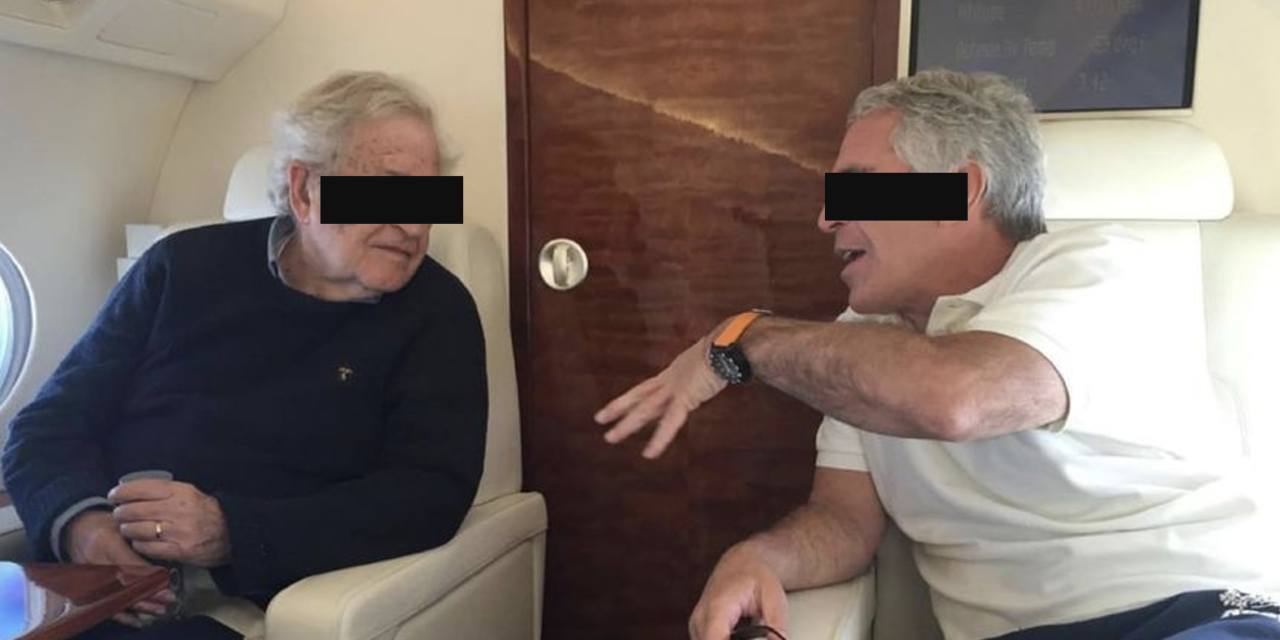
When Noam Chomsky’s name appeared in the Epstein files, there was, not surprisingly, quite a bit of discussion. Much of that discussion came in the form of criticism of Chomsky for his friendship with Epstein. I’ll get to that criticism and whether it landed, but what was most interesting to me was that, woven into the criticism, was a certain perspective about the nature of friendship itself. And I have to confess that the perspective troubled me. It prompted me to write this essay, which isn’t really about Chomsky and Epstein. It’s about friendship — what it is, what it’s for, and what we have not-so-quietly started to demand of it. And to get at that, I plan to tell you about a friend of my own.
Chomsky, as many know, maintained a friendship with Epstein that continued after Epstein’s 2008 conviction for soliciting a minor for prostitution. As of this writing, Chomsky is ninety-seven years old and suffered a debilitating stroke in June of 2023. Reports about his health range from positive (he “raised his hand to protest events in Gaza”) to bleak. A written apology for the relationship was issued by his wife Valeria, using the language “Noam and I,” but it is unclear whether he had a hand in its authorship.
To be sure, there are things in the Epstein files that are worth criticizing — if they hold up. There is, for example, a letter, undated, unsigned, on no letterhead, addressed to “Whom It May Concern,” that is supposed to be from Chomsky. It praises Epstein in terms so effusive they sound distinctly anti-Chomsky. Indeed, several people who know his prose well, including Norman Finkelstein, questioned its authenticity when it surfaced, noting it could just as easily have been drafted by Epstein himself. If Chomsky did write that letter, and the intent was to be used for public consumption, it would deserve criticism, not because Chomsky was friends with Epstein, but because running PR for a convicted sex offender is a different thing from being his friend. The distinction is important.
Chomsky’s former administrative assistant, Bev Boisseau Stohl, who read thousands of the letters Chomsky wrote during her years overseeing his schedules and correspondence between 1993 and 2017, had this to say: “What I never saw, even in his most vulnerable moments, when sharing his deepest feelings of sadness and regret, was the kind of laudatory language, romantic hyperbole, clichés, and tone of voice found in the cherry-picked letters of recommendation and support that made their way into the released Epstein files.”
If you believe the documents are authentic and want to criticize him for authoring them (or some of them), that’s a topic for another day. I have a different point to make now: there is something troubling about the criticism of Chomsky/Epstein friendship itself. And let there be no mistake that critics have been very specific in criticizing the friendship itself.
Listen to Vijay Prashad, one of Chomsky’s co-authors: “There is nothing to say on his behalf. When the photos and emails appeared, I was immediately disgusted by Epstein’s paedophilia, and so by Noam’s friendship with him. There is no defence for this, in my view, no context that can explain this outrage.” And Ralph Leonard in the New Statesman: “Chomsky’s status as a ‘dissident’ intellectual is in contradiction with his friendship with Epstein… How could he not see Epstein for what he was: a patrician pimp?”
Notice what these statements are actually saying. They aren’t saying that Chomsky aided Epstein’s crimes, nor that Chomsky knew about the abuse and covered it up. They also aren’t saying that Chomsky recruited victims or provided access or was complicit in any specific harm. Nor are they saying that Chomsky participated in a public campaign to defend or rehabilitate Epstein’s reputation. The charge is simpler and stranger than any of that: he was friends with a bad man. The friendship itself is the crime.
This is the thing I want to examine, because I think it reflects a badly warped idea of what friendship is. While Epstein’s crimes are an embarrassment to our culture and political class, the true nadir of our culture can also be seen in the self-righteous posturing; in the claims that friendship should be in the service of the political, the professional, and the burnishing of our reputations. There is certainly room for moral outrage about Epstein. But some moral outrage should also be saved for the self-righteous poseurs who have crawled out of the woodwork to join the chorus of denunciations aimed at the friendship itself.
———
I began this essay with the case of Chomsky and Epstein, but my point isn’t about them per se. It is really about friendship itself, about what anchors friendship, and what happens when our culture comes to view friendship as either transactional value extraction or an opportunity to polish one’s reputation. I want to argue that our current view of friendship reflects a deep sickness in our culture, a sickness from which I fear there may be no recovery. For if we view friendship as a tool to advance our social capital, what have we become?
My route into this question is not through Epstein and Chomsky alone, but also through something more personal. I also want to view things through the lens of my friendship with Miguel (not his real name), whom I met while living in Mexico some years ago.
Miguel sold tours on Quinta Avenida in Playa del Carmen. He also sold a little weed for the local cartel, and possibly some coke, and he was — let me not be coy about this — in the game. Just how far into the game he was, I didn’t know at the time, and I still don’t entirely know. What I did know was that everyone selling tours in Playa del Carmen was in the game. Probably everyone in town was in the game, from the taxistas to the mayor. They didn’t carry cartel ID cards, but they all had a final boss, and that boss was a cartel jefe or jefa.
Over a period of months, I became close to Miguel. As a tour guide, he took my friends and me on many day trips to cenotes and Mayan temples. That led to many hours of conversation. He did favors for me from time to time as well. Sometimes he would work security for me when I went to the bank. Sometimes he took me to the airport. We often went to Sam’s Club in his SUV to load up on enormous quantities of fruit.
It sounds like a transactional friendship so far, but at some point, it was very clear that it was more than that. You know what I am talking about. At some point, you realize you are just very relaxed and comfortable with someone and are free to discuss whatever pops into your mind. The transactional was braided through our friendship as it was through all friendships. Friends do things for each other, after all. But at some point, you recognize that it is more than that.
Eventually, Miguel would stop by my place after work so he could blaze before he went home (his wife didn’t let him smoke weed in their house). Other times, we would chill in a local dive bar. However, he was quite religious about getting home to his family with plenty of time for them.
Another marker of friendship is when you get up to crazy stuff together, like the time he bought a drone with the plan to use it to film weddings. Whether he actually got a customer, I don’t recall, but there were certainly plenty of hours of pointless airborne tricks with the drone.
As we became closer, Miguel opened up about his job, and I learned about the true centers of power in Playa del Carmen and in Mexico. He was at that time working, to some extent, for a group that was called “the Pelones” (literally “the Bald Ones”), which had spun out of a paramilitary wing of the Sinaloa cartel (much as the Zetas had been a paramilitary wing that spun out of the Gulf Cartel). I questioned him for hours about how the cartels worked — about the Sinaloa Cartel, the Gulf Cartel, the Zetas, the (at the time) newly arrived New Generation Cartel from Jalisco. We talked about the other cartels, too: The Knights Templar (aka the Familia Michoacana) and their Evangelical Christian leader (San Nazario). He seemed particularly troubled about a new cartel that had recently arrived from Guatemala, still smelling (he said) of the jungle. In the fullness of time, it seemed like the veil had been lifted and I could, for the first time, see the power structures that really controlled Mexico. I could see where they held their power, how they acquired it, and what they were doing with it.
I also learned more about Miguel’s past. He was not Mexican, it turned out, but Salvadoran; much of his early life was spent in the United States, when he had been a member of MS-13. Miguel had done time in “juvie” in the United States and had done serious time in a Salvadoran prison where the toilets backed up so badly that the shit piled up on the floor, the lights didn’t work half the time, and you could hear people getting beaten all night long. He’d been stabbed there — by a guy with a sharpened mop handle who didn’t even bother to offer a reason. He was later stabbed again by a coyote in the Arizona desert on one of his illegal passages into the United States. He had also been jailed in Mexico. Salvadoran prisons, he assured me, were the worst.
Eventually, you realize you aren’t just friends with one person but with something like a family, even if that family is, frankly, kind of a mess. One day, Miguel announced that his former wife in Chiapas had died and his 8-year-old son was coming to live with him. It was either that or go live with his Zapatista uncle in the jungle. No one seemed to want that. After that, he brought his son to my house from time to time (I’ll call him “Wilfredo”). I set Wilfredo up with some used video games I had, and he could not contain his excitement – he hopped around in a tight circle, as though his left foot was nailed to the floor. Somewhere, he had learned to manage his excitement.
Miguel, on the other hand, was worried. He was having trouble getting his kid into the local school. I gave Miguel a fat stack of pesos and told him to use that to get his kid into school. It worked! Obviously. And Miguel was forever grateful.
My financial gesture flipped some switch in Miguel’s brain. He became even more of a family guy, and he liked his new, improved family life so much that he decided he wanted to reconcile with his parents, who had since left El Salvador and were now living in the United States.
Miguel began by opening a line of communication with his mom, then with his dad, and told them he had a new family, was very successful, lived in Playa del Carmen, made all kinds of money in the tourism industry, and that they should come visit. And after a few months, they did come: His mom, his dad, his aunt, and two cousins he had never met. He set them up in a condo not far from the beach and then took them on tours almost every day – to the cenotes, to Isla Mujeres, to Cozumel, and even to Mérida for shopping.
By the time they boarded their flight back to California, his mother kissed his forehead and told him she was proud of him. His father clapped him on the shoulder and called him “mijo” again, as he used to when Miguel was a boy.
Some weeks later, I went truck shopping with Miguel in a giant parking lot in Mérida. I stood around drinking fermented pineapple juice from a plastic bag while Miguel negotiated with carteleros who were unloading year-old trucks with dubious histories. They kept looking over at me and my bag of fermented juice, wondering what that was about.
Eventually, Miguel found a truck that he wanted and negotiated a deal with a family of six. Miguel closed the deal by throwing in the drone and a pair of Wilfredo’s sneakers. Miguel was elated with his new purchase, but a couple of days later, he was crestfallen. His father had been up in his business: “Why do you need a truck?” I explained to Miguel that that was the cost of having a dad in your life; he was going to be up in your business all the fucking time.
I am not here to tell you Miguel was a good man in the clean, uncomplicated sense. He wasn’t. But I will tell you he was my friend, and that friendship was valuable in itself — for me, and I think for him. And I will tell you that anyone who thinks the morally correct response to having a friend like Miguel is to terminate the friendship or to denounce him publicly has a badly warped idea of what friendship is.
———
Our current sad view of friendship has a long pedigree in the Western tradition. Aristotle, in the Nicomachean Ethics, gives us a taxonomy of friendship that begins innocently enough and ends with a velvet rope. There are friendships of utility, friendships of pleasure, and — the rarest and most exalted — friendships of virtue. The first two are disposable; they persist only as long as the benefit or enjoyment does. But the third is supposed to be something higher: two individuals, equal in virtue, recognizing and loving the good in one another, living together in shared activity, each a reflection of the other’s excellence. A friend, Aristotle tells us, is “another self.” It is a beautiful thought, until one asks who is allowed to count as such a self.
The problem is that the theory’s structure quietly does the work of exclusion. Virtuous friendship requires equality; equality requires equal virtue; and full virtue, in Aristotle’s world, is effectively restricted to free male citizens. Women, slaves, noncitizens — these may participate in lesser, derivative forms of friendship, but not in the complete form. The conclusion is not always stated baldly, but it is unavoidable: the highest form of human relation is reserved for those who already occupy the highest rung of the social order. Friendship becomes less a discovery between persons than a confirmation of status. “We are the virtuous,” the theory implies, “and therefore we alone can be true friends.”
There is something deeply corrupt in that move. It is not merely that Aristotle’s empirical assumptions are wrong — though they are — but that the structure of the view licenses a familiar and dangerous claim: that some people are entitled to deeper forms of human connection because they are better. Friendship, on this account, becomes a kind of ethical aristocracy, a reward for those who already meet the standard. It is a way of polishing one’s standing among the already approved. And once you see it that way, the whole edifice looks less like a theory of friendship and more like a theory of exclusion.
Contrast this with the theologian Martin Buber’s notion of the I–Thou relation. For Buber, the deepest form of human relation does not depend on prior virtue, nor does it arise from the recognition of admirable traits. It is not an evaluation at all. It is more like an encounter. In an I–Thou relation, the other is not an object to be assessed, categorized, or measured against a standard of excellence. The other is present — irreducibly, without mediation — and the relation itself becomes the primary fact. It doesn’t matter how you got into the relationship. The fact of the matter is that you are there. One does not enter into I–Thou because the other is virtuous; one enters into it because one refuses to reduce the other to an “It.” It is not a tool for building reputations.
This shift is key. Aristotle grounds friendship in what the friends are; Buber grounds it in how they relate. Aristotle’s model is, in the end, selective and exclusionary; Buber’s is structurally open to anyone capable of entering the relation. And it is here that a more honest account of friendship begins to emerge. For if we are candid, none of us meets Aristotle’s standard of full virtue. We are inconsistent, compromised, uneven. If friendship required perfected character, it would scarcely exist at all. When people object that a friendship is not virtuous, they betray their own lack of virtue. At their core, they cannot fathom a non-transactional relationship.
So perhaps we should invert the picture. The value of friendship does not lie in the prior virtue of the participants, but in their fidelity to the relation. Friendship is not something you qualify for; it is something you sustain. It is not a mirror of excellence, but a practice of commitment. You are friends with the other not because they exemplify the good, but because the relation itself has become a site of meaning — one that you refuse to abandon, even when confronted with their flaws, and, if you are being honest, your own.
On this view, friendship is not for securing one’s reputation among the “virtuous.” It is not an exchange of mutual admiration between the already accomplished. It is the construction — fragile, ongoing, and often difficult — of an I–Thou relation in a world that constantly pushes us back into I–It. To be a friend is not to certify another’s virtue, but to stand in relation to them without reduction and without the illusion that either of you has earned the right to be there. To remain someone’s friend is not to acquit them. Friendship is not a verdict. It is a human relationship.
———
Here is the thing about friendship that people seem to have forgotten: it is not a co-branding arrangement or a mutual endorsement deal. What the Chomsky-Epstein discourse reveals is that many people have quietly replaced friendship with what I’ll call “reputational management.” The idea is: you associate with people who make you look good, you disassociate from people who make you look bad, and you dress this whole exercise up in moral language, so it seems like you’re taking principled stands rather than merely doing social bookkeeping. It’s “Church Lady” ethics: you’re not actually doing anything good; you’re just keeping your record clean. You can attend church with your head held high.
The tell in the Chomsky denunciations was the speed and the slippage in the denunciations. Prashad says he was “disgusted by Epstein’s paedophilia, and so by Noam’s friendship with him.” Read that again. The disgust at Epstein’s crimes slides directly, without argument, into disgust at the friendship. As if the friendship and the crimes were equivalent. As if having a friend who does terrible things is the same as doing those things yourself. This is not moral reasoning. It looks more like moral contagion theory — the idea that association with the impure makes you impure, regardless of what you actually did. Unspoken was the transitivity of it all: if the friends of the impure are impure, then so are the friends of the friends. When in doubt, denounce. It sometimes seems to be the only currency that people accept these days.
The second tell is how quickly the denunciations came. Real moral reckoning takes time. It involves thinking about what happened, what was known, what was done, and then about what the proportionate response is. The pile-on had none of this.
———
There are times when you have to put the brakes on a friendship. If your friend is hurting people and you are covering for them, you are not being loyal — you are being an accomplice. That is a real distinction, and it matters enormously. If the disputed letter is genuine — if Chomsky really did write an unsolicited character reference for a convicted pedophile and it was intended to be used publicly — that deserves criticism, and not because of the friendship but because of what the letter did: it put his name in the service of Epstein’s rehabilitation. That is a specific harm, of a specific kind, worth naming specifically.
But that is not what Prashad and Leonard are criticizing. They are criticizing the friendship. Full stop. And a friendship — even with a very bad person — is not in itself a harm. It is a relationship between two human beings that may contain all sorts of things we cannot see from the outside: history, loyalty, genuine affection, and mutual recognition of something real in the other person. To demand that such a relationship be dissolved or publicly renounced the moment it becomes reputationally inconvenient is to treat friendship as purely instrumental — as something that exists only to serve your image.
That, it seems to me, is the real betrayal of values.
———
I understand there are nuances here, and I’ve gone over them with my friends. One objection is that this isn’t guilt by association at all; it’s rather that some people are simply beyond the pale — terrible enough that friendship is off the table no matter what the friendship contains. Hitler and Epstein are the cases everyone reaches for. Fine. But notice what happens the moment you try to say who else makes the list. I’ve been told, variously and by different people, that the unfriendable include Trumpistas, Zionists, the gender-critical, cartel enforcers, and — you know — that sort of person. The lists don’t agree. They don’t come close to agreeing. Each person’s roster of the unfriendable turns out to be a tidy map of the people that person already couldn’t stand. That is the first sign that “terrible enough” is not measuring terribleness. It is measuring something else.
Suppose we tried to be principled and fix an actual threshold — a line of complicity past which a person is no longer a permissible friend. Where would we put it? Complicity is not rare and it is not clean; it is the water we swim in. The cartels exist because we buy the drugs, and the drug money moves the trafficked people. We live in a country that lets its addicts die in the street; a country that bombs innocents and bankrolls other countries while they bomb innocents; a country that is, as I write this, in point of fact run by Trumpistas. And academia, which I know best, runs on money that is bloody if you follow it back far enough. Set the complicity threshold to catch a friendship with Epstein, and it will catch friendships with the arms contractor, the sanctions economist, the museum board, the university, and — if you are honest about your own past and the fabrication of the phone in your own pocket — it will catch you. Set it high enough to spare all of them, and you have quietly conceded that mere complicity was never what put Epstein beyond the pale. Either the principle eats the world, or it was never really a principle.
Here someone might say that a friendship with Epstein isn’t a matter of mere complicity — his victims were children, and that is a bright line, not an arbitrary one. I agree that it is a bright line. But watch where the line actually gets drawn. The people wielding it against Chomsky do not, as a rule, refuse to break bread with the people who ran the drone program, or built the carceral system, or designed the sanctions that starved a country’s children one continent away. Those people keep their friends, their board seats, and their honorary degrees. The bright line comes out of its sheath only for the person who is radioactive this week — the one whose name in your contacts has become a liability. Which means the line being enforced is not the moral one. It is the reputational one.
And that is the trick laid bare. “Unfriend the truly terrible” has the grammar of a moral principle, but no one can state the threshold, the lists never agree, and the line that actually gets enforced tracks not how bad a person is but how bad it currently looks to know them. Cutting loose the selected, legible, convenient few does nothing for a single victim of anything. It is not a remedy for complicity; it is a remedy for exposure — a way to keep your own record clean while the machine you are plugged into runs exactly as before. Which is to say we are back where we started: not ethics, but reputation management in an ethical costume.
An alternative objection is that high-status friends were part of what kept Epstein credible and operational after 2008 — that elite friendship with him wasn’t inert but did causal work in laundering his reputation (with or without those letters on Epstein’s hard drive). This objection concedes that running PR is different from being his friend, but suggests that distinction has a missing middle: just being known as Epstein’s friend, by someone of Chomsky’s stature, may confer cover without any letter or PR campaign.
I take this seriously because, unlike the contagion charge, it points to a real harm to real people. But look at what must be true for this objection to land. The cover-conferring power of a friendship is not a fact about the friendship; it is a fact about a social convention — the convention that reads whom a person befriends as a public verdict on that person’s worth. And that convention is precisely the sickness this essay is about. Once you see that, the objection cannibalizes itself. To blame Chomsky for the laundering effect of his friendship is to insist that he was obligated to curate his friendships for the social optics — to drop a friend not because the friendship had failed, but because the association had become a liability to third parties reading the tea leaves. It has teeth only if Chomsky was morally required to treat Epstein as an It: a reputational asset to be managed, rather than a person to be in relation with. But that is the very demand I have been arguing we should refuse. You cannot indict a man for declining to play a game whose existence is the thing we ought to be indicting.
———
In saying these things, I don’t mean that we shouldn’t have boundaries within our friendships. I hit an inflection point one day when Miguel, in a dark mood, was watching MS-13 videos of prisoners being decapitated with machetes. I told him I didn’t want to see that. Was that the moment to unfriend him? Are there actually supposed to be social norms for this sort of decision? Should that not have been my personal decision?
Sometimes, of course, friends try to drag you into their mess, or sometimes you invite yourself into their mess. That’s a bad outcome, but it doesn’t have anything to do with the friendship per se. It only has to do with the boundaries you establish within that friendship. If you can’t set internal boundaries, most friendships are probably a bad idea for you. Maybe all of them are.
Some people have argued that Epstein manipulated Chomsky into a friendship for some sort of we-don’t-understand-how-it-works Epstein-class chicanery. On the flip side, people have been upset that Chomsky let himself be manipulated in this way. How could such a giga-brained linguist not see that he was a pawn in Epstein’s game? We see this move all the time: “You shouldn’t let people manipulate you like that.” People have literally gotten angry at me for this. And I get that if it becomes a habit, that can be annoying for friends who have to pick up the pieces., Bbut was Chomsky in the habit of collecting manipulative sociopathic friends? I don’t know, and neither do the people complaining about him on Facebook.
Or maybe Chomsky was trying to establish his reputation as a bad boy. I mean, I suppose it’s possible, but it seems off-brand to me. It seems more likely to me that Chomsky saw complicit criminality everywhere, even in himself, and he wasn’t about to keep a scorecard of relative evil just to pick his friends. I thought about this regarding Miguel. Was Miguel (with his videos of decapitations and all that) actually a worse person than the gringos I befriended in Mexico or the academics I had befriended on the international conference circuit? No. He was not. Of this, I am sure.
———
A couple of years into my friendship with Miguel, he disappeared. He didn’t appear at his kiosk. The people working there played dumb (“Don’t know him”). He didn’t call. He had no social media footprint, so it was no use looking him up on Facebook. I became concerned. Eventually, I did a web search on Miguel’s full name; there were only two hits. The first had to do with his arrest for robbing an OXXO convenience store a few years earlier. Then I opened the second link.
Mexican newspapers are fond of covering their front pages with gory photos from car accidents and assassinations. The pictures would be unthinkable in the United States, but in Mexico, you couldn’t buy a pack of gum at OXXO without confronting a car accident victim, still pinned in the car, or a narco lying in a pool of blood. You see those a lot, and you don’t think that much about it until it’s your friend.
And there Miguel was, on the front page of some local rag, lying on the ground in a pool of blood – or rather over a big smear of blood; he apparently tried to crawl away. First thoughts are funny. My first thought was “Nice haircut, bro, looks sharp,” and my second thought was “Those fucking camo shorts look like shit, bro, why did you have to die in those?” And then I tried to read the article … to read how Miguel was shot down in front of his own house with the family inside … got to the description of his SUV, and I turned off the monitor. I stared at the blank screen, not really feeling anything. Not really thinking anything. Honestly, ten years later, I’m still not over that. I wrote a 350-page book about it that sits on my hard drive to this day. There isn’t much else I could do.
Recently, I’ve been thinking about a question that no one in all their enlightened pontificating about the Chomsky/Epstein friendship seems to have asked: what did Chomsky feel when he learned that his friend had possibly been strangled to death in jail? Good guy, bad guy, or just a regular guy, that is a horrific thing to have happen to a friend.
———
The thing I can’t help but come back to is all the people using this sad affair to burnish their ethical reputations – to show that by denouncing the man because of his friendship with Epstein, they are thereby good people. I don’t see their behavior as a sign of goodness. As I said, I view it as a symptom of a sick culture. Anyone who demands that we subvert friendship in the alleged service of the ethical isn’t just making an ethical miscalculation; they are showing us that they have a morally empty conception of what true friendship is. They have, in fact, untethered friendship from the realm of the moral.
Here is the question I would put to the people keeping score — not as an accusation but as a genuine question, because I don’t think they have asked it of themselves. When someone you love becomes inconvenient — when the association starts to cost you something, when the smart move is to release the statement and step back — what will you actually do? I said in my discussion of Buber’s I–Thou that the virtue of friendship lies not in who we are but in the fact that we stay. I stayed with Miguel. I would do it again — the cenotes, the drone, the fat stack of pesos, the ugly camo shorts. If I were some important person with a reputation to maintain, I don’t know whether I’d have had the nerve to stay Chomsky’s friend with the cameras rolling and the Epstein files dropping; that test never came for me, and I won’t pretend otherwise. But I know which failure I would rather answer for at the end. I would rather answer for keeping a friend who turned out to be a worse man than I knew. I would rather not answer for stepping away from a friend because keeping him made me look bad.
To remain someone’s friend is not to acquit them. Friendship is not a verdict. It is a human relationship.