
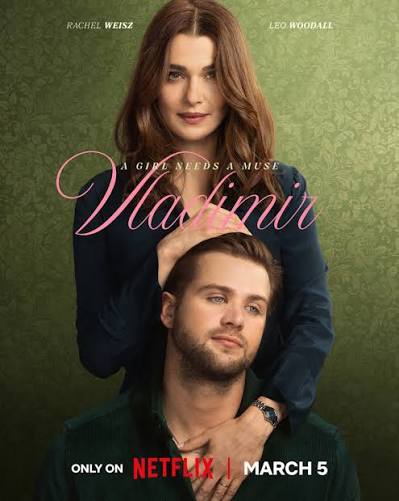
Vladimir, the series, suggests with its titular nod to Nabokov and to the English depts that (may) still teach him, that the series is about obsession, especially the age-inappropriate kind, as well as desire for lost youth in a relentlessly youth-centered culture. These two themes, and the gap between the generations’ judgments of them, are what the series is ostensibly about.
Seen that way, it is fully cringe-inducing to watch the characters flirt and take chances, risking exposure or rejection for inappropriate or unwelcome advances across divides of age, gender, and power. The audacity of an older woman (M, played by Rachel Weisz) who does and does not stand by her man, combined with that same character’s shocking mendacity, calls to mind none other than Martha in Edward Albee’s Who’s Afraid of Virgina Woolf ? Perhaps M is to suggest Albee’s Martha? But, although, in the first episode, M and her husband John do, like Albee’s Martha and George, eviscerate one another at a dinner, this cruelty is not their norm. They actually seem to have a good enough marriage.
Rachel Weisz is brilliant as the older woman narrator, M, a popular professor who might be falling apart at the seams as her philandering husband, John (John Slattery), is charged with Title IX violations. For her part, M. seems to be reaching for one last adventure before her time as a sex object is up. (“I may not be the cause of a spontaneous erection again,” she muses in the series’ opening monologue.)
The series is marketed as an exploration of desire and its (dis)appointments. But at a certain point it quietly crosses from Nabokov and Albee into Stephen King, whose novel Misery is mentioned in passing as it is seemingly reenacted: it turns out the fading promise that is most feared here is actually writer’s block.
All the viewer’s cringiness about the characters’ risked or rejected sexual advances disappears, in my view, once it becomes clear that the centering problem of the series is not the quest for sex but what that quest here proxies: Vladimir is a show about writing and the lengths to which writers will go to find new stories. It is perhaps ironically self-aware, then, when it announces its debts to Albee, Nabokov, King, and Du Maurier’s Rebecca.
The setting is a small college, whose English dept. is host to bedhoppers and moralists (often the same people), and is headed by an iconic, conflict-avoiding (and therefore conflict-causing) nice-guy department chair. Albee’s midcentury murderousness is replaced by a provincialism whose little rivalries barely hide beneath a veneer of faculty talk of responsibility to students. The challenge is to escape the fate of these unambitious has-beens, and both the newest and oldest members of the department seem to know it. When M is horrified to realize she has missed the deadline for turning in an undergraduate recommendation letter, the suggestion is (or will soon be) that such forgetting is necessary for her survival as a writer. She has not written anything for 15 years.
At this point, the show becomes utterly delightful, a kind of madcap romp as the two leads try to extract from each other the magic elixir of creativity. If this sounds vampiric, the name Vlad certainly seems to confirm it. It seems Nabokov and Albee, King, du Maurier (and Sontag, conjured by the final episode’s title, “Against Interpretation”) are McGuffins. Dracula and Twilight are the real source texts.
All four of the main characters are writers. Vlad (Leo Woodall) is the promising young genius, the dept’s most recent hire, who puts everything on the line to collect material for his second book. Having been praised fulsomely for his first, he is looking for his next big thing. Cynthia (Jessica Henwick), Vlad’s wife, seems dependent on her husband, emotionally and financially, but she is writing a memoir that is her story. Indeed, one tip that her husband is a bloodsucker comes when Vlad tells M that Cynthia had spent time in a mental asylum. Vlad also tells M that when Cynthia discovers he wrote a story about her experience, she forced him to throw it away. Was Cynthia protecting her privacy? Or her copyright? It is unclear. But when Vlad is forced by her to destroy his writing, we share his shock, somehow, until we realize this is his habit. He will do it again.
M, the narrator, seems totally overtaken by her desire for Vlad who should be out of reach since he is both married and decades younger. But she, too, turns out to be in search of material and he just a prop, a return of the favor to patriarchy, she might have said in one of her undergraduate lectures on women in American literature.
We might see the collapse of M’s professional life as caused by her distracting fantasies about Vlad. But the real distraction that leads to her undoing is writing, which blossoms in the low light of her fantasies. M steals time to write the way another woman might steal off to meet a lover. Indeed, in their long-awaited consummation, M orgasms quickly, and then tells Vlad to finish up. He is not the real object of her desire. Writing is. And, after years of not-writing, M is writing again. It is as if she has awakened after a long slumber. That a great deal of time has passed in the interim is apparent in her use of longhand to write, on paper notepads, in an age of laptops. Like any vampire, she is an anachronism in a world that has moved on.
There is a fifth important figure, also compellingly played: Sid (Ellen Robertson), M and John’s grown daughter, nonbinary in appearance, is possibly following in her parents’ footsteps, but which one? Like her father, she has had a fling with a junior co-worker. But a nearly out of body experience of train sex suggests she may be prone to a certain vampirism, like her mother.
Sid is a lawyer who knows the importance of story-telling – “you need to tell a better story than they do,” she says to M about the upcoming Title IX hearing. But her mother will not attend. Sid, enlisted against her mother’s wishes by her father to represent him, pulls out all the stops to save him. But the hearing surfaces such a plethora of stories about her father’s harms, that they can no longer be waved off (though they will be). In the end, Sid is the only storyteller who confronts her own predations and cruelty in the service of a story. She leaves for New York where, the implication is, she will be insulated from all the horror of provincialism. But then, she is not a writer, or she might have felt compelled to stay for the ending.
